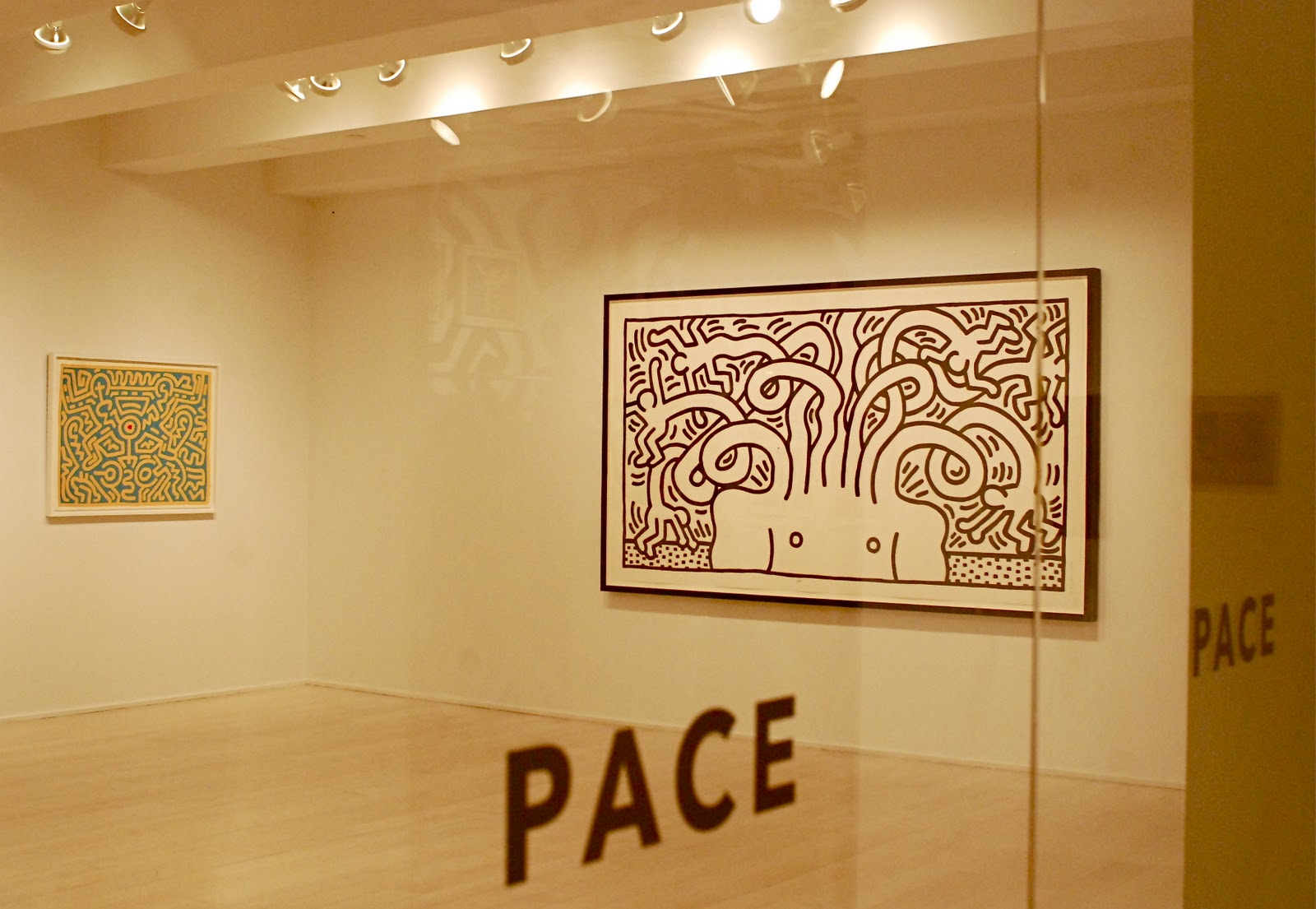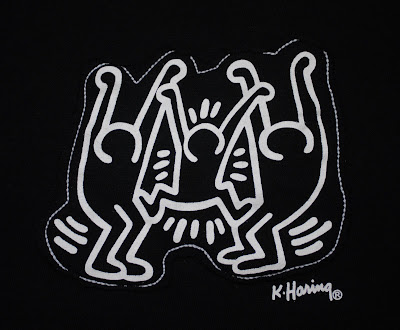


These are some of the KEITH HARING pop art t-shirt designs available at UNIQLO in Soho. Keith Haring is best known for his pop art, his bold lines and active figures that carry poignant messages of vitality and unity. Uniqlo, the new-style Japanese firm making reasonably priced casual clothes, is located at 546 Broadway in Soho.
Keith Haring biography from haring.com:
Keith Haring was born on May 4, 1958 in Reading, Pennsylvania, and was raised in nearby Kutztown, Pennsylvania. He developed a love for drawing at a very early age, learning basic cartooning skills from his father and from the popular culture around him, such as Dr. Seuss and Walt Disney.
Upon graduation from high school in 1976, Haring enrolled in the Ivy School of Professional Art in Pittsburgh, a commercial arts school. He soon realized that he had little interest in becoming a commercial graphic artist and, after two semesters, dropped out. While in Pittsburgh, Haring continued to study and work on his own and in 1978 had a solo exhibition of his work at the Pittsburgh Arts and Crafts Center.
Later that same year, Haring moved to New York City and enrolled in the School of Visual Arts (SVA). In New York, Haring found a thriving alternative art community that was developing outside the gallery and museum system, in the downtown streets, the subways and spaces in clubs and former dance halls. Here he became friends with fellow artists Kenny Scharf and Jean-Michel Basquiat, as well as the musicians, performance artists and graffiti writers that comprised the burgeoning art community. Haring was swept up in the energy and spirit of this scene and began to organize and participate in exhibitions and performances at Club 57 and other alternative venues.
In addition to being impressed by the innovation and energy of his contemporaries, Haring was also inspired by the work of Jean Dubuffet, Pierre Alechinsky, William Burroughs, Brion Gysin and Robert Henri’s manifesto The Art Spirit, which asserted the fundamental independence of the artist. With these influences Haring was able to push his own youthful impulses toward a singular kind of graphic expression based on the primacy of the line. Also drawn to the public and participatory nature of Christo’s work, in particular Running Fence, and by Andy Warhol’s unique fusion of art and life, Haring was determined to devote his career to creating a truly public art.
As a student at SVA, Haring experimented with performance, video, installation and collage, while always maintaining a strong commitment to drawing. In 1980, Haring found a highly effective medium that allowed him to communicate with the wider audience he desired, when he noticed the unused advertising panels covered with matte black paper in a subway station. He began to create drawings in white chalk upon these blank paper panels throughout the subway system. Between 1980 and 1985, Haring produced hundreds of these public drawings in rapid rhythmic lines, sometimes creating as many as forty “subway drawings” in one day. This seamless flow of images became familiar to New York commuters, who often would stop to engage the artist when they encountered him at work. The subway became, as Haring said, a “laboratory” for working out his ideas and experimenting with his simple lines.
Between 1980 and 1989, Haring achieved international recognition and participated in numerous group and solo exhibitions. His first solo exhibition in New York.was held at the Westbeth Painters Space in 1981. In 1982, he made his Soho gallery debut with an immensely popular and highly acclaimed one-man exhibition at the Tony Shafrazi Gallery. During this period, he also participated in renowned international survey exhibitions such as Documenta 7 in Kassel; the São Paulo Biennial; and the Whitney Biennial. Haring completed numerous public projects in the first half of the 80’s as well, ranging from an animation for the Spectacolor billboard in Times Square, designing sets and backdrops for theaters and clubs, developing watch designs for Swatch and an advertising campaign for Absolut vodka; and creating murals worldwide.
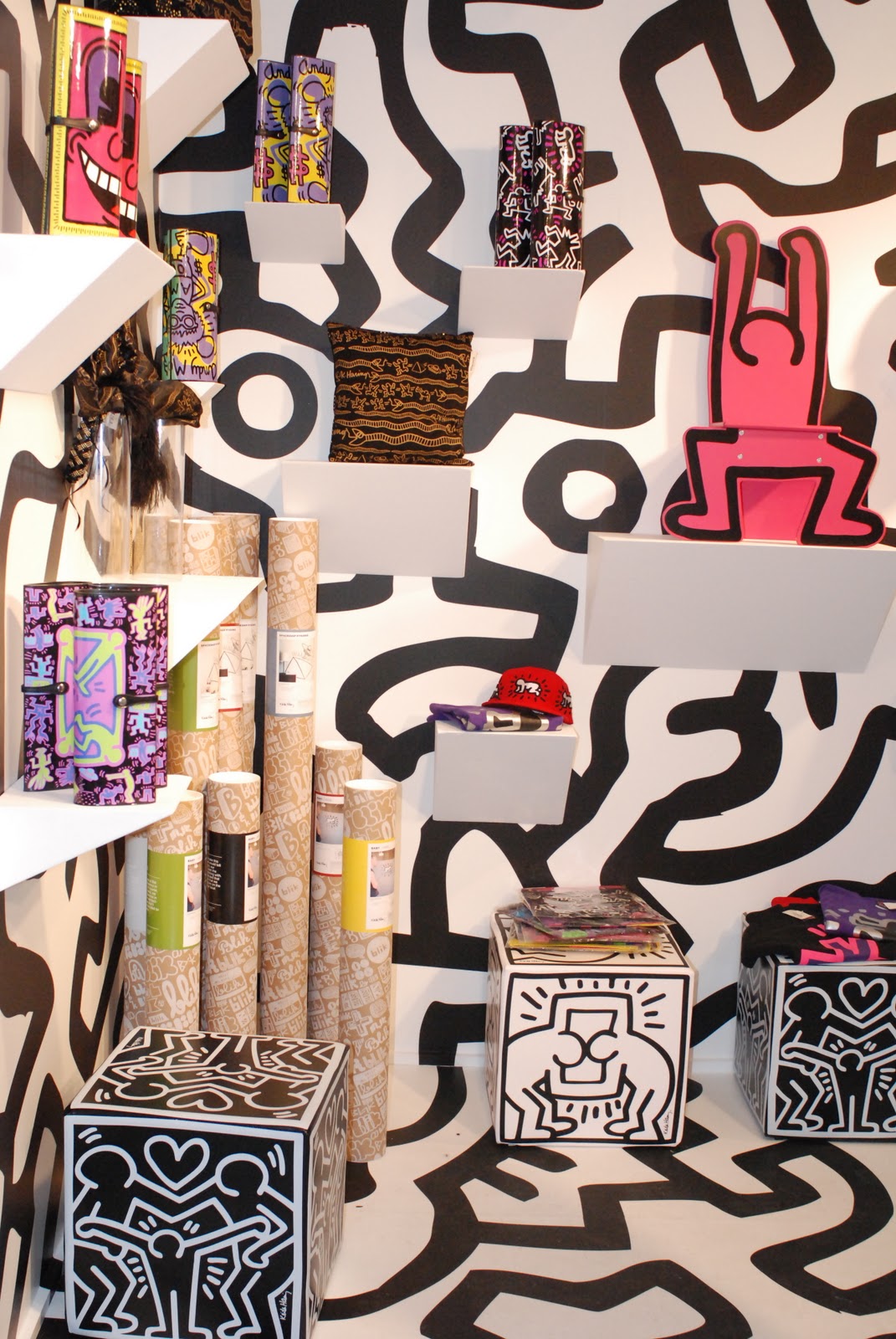
In April 1986, Haring opened the Pop Shop, a retail store in Soho selling T-shirts, toys, posters, buttons and magnets bearing his images. Haring considered the shop to be an extension of his work and painted the entire interior of the store in an abstract black on white mural, creating a striking and unique retail environment. The shop was intended to allow people greater access to his work, which was now readily available on products at a low cost. The shop received criticism from many in the art world, however Haring remained committed to his desire to make his artwork available to as wide an audience as possible, and received strong support for his project from friends, fans and mentors including Andy Warhol.
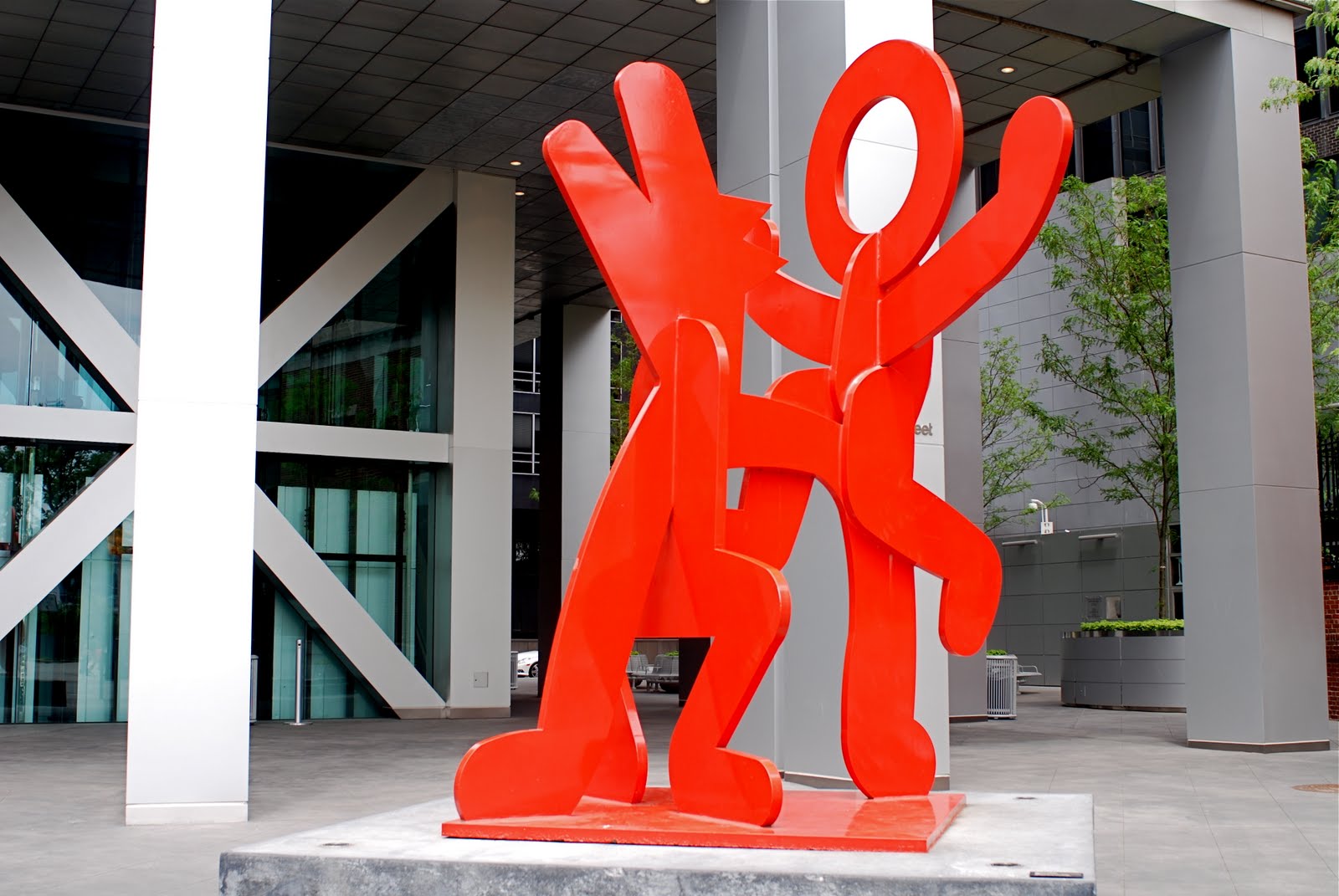
Throughout his career, Haring devoted much of his time to public works, which often carried social messages. He produced more than 50 public artworks between 1982 and 1989, in dozens of cities around the world, many of which were created for charities, hospitals, children’s day care centers and orphanages. The now famous Crack is Wack mural of 1986 has become a landmark along New York’s FDR Drive. Other projects include; a mural created for the 100th anniversary of the Statue of Liberty in 1986, on which Haring worked with 900 children; a mural on the exterior of Necker Children’s Hospital in Paris, France in 1987; and a mural painted on the western side of the Berlin Wall three years before its fall. Haring also held drawing workshops for children in schools and museums in New York, Amsterdam, London, Tokyo and Bordeaux, and produced imagery for many literacy programs and other public service campaigns.
Haring was diagnosed with AIDS in 1988. In 1989, he established the Keith Haring Foundation, its mandate being to provide funding and imagery to AIDS organizations and children’s programs, and to expand the audience for Haring’s work through exhibitions, publications and the licensing of his images. Haring enlisted his imagery during the last years of his life to speak about his own illness and generate activism and awareness about AIDS.
During a brief but intense career that spanned the 1980s, Haring’s work was featured in over 100 solo and group exhibitions. In 1986 alone, he was the subject of more than 40 newspaper and magazine articles. He was highly sought after to participate in collaborative projects ,and worked with artists and performers as diverse as Madonna, Grace Jones, Bill T. Jones, William Burroughs, Timothy Leary, Jenny Holzer, Yoko Ono and Andy Warhol. By expressing universal concepts of birth, death, love, sex and war, using a primacy of line and directness of message, Haring was able to attract a wide audience and assure the accessibility and staying power of his imagery, which has become a universally recognized visual language of the 20th century.
Keith Haring died of AIDS related complications at the age of 31 on February 16, 1990. A memorial service was held on May 4, 1990 at the Cathedral of St. John the Divine in New York City, with over 1,000 people in attendance.
Since his death, Haring has been the subject of several international retrospectives. The work of Keith Haring can be seen today in the exhibitions and collections of major museums around the world.