Showing posts with label Tony Rosenthal. Show all posts

Thursday, September 9, 2010

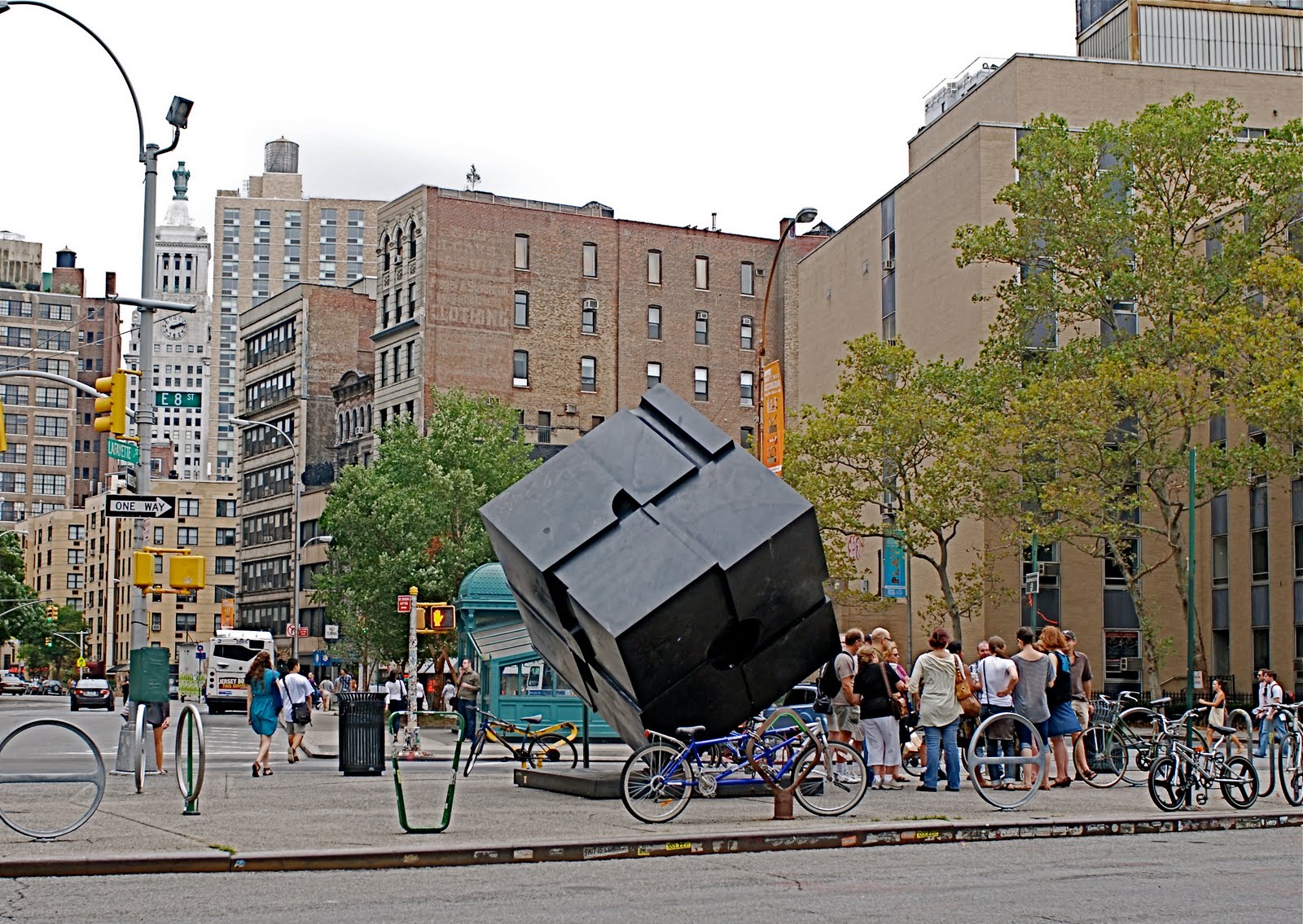
"Alamo" by Tony Rosenthal


Also referred to as the "Astor Place Cube," this is "Alamo" (1966-1967) by Tony Rosenthal, installed at a traffic Island at Astor Place, Lafayette Street at 8th Street. The piece is made of painted CorTen Steel, 15 x 15 x 15 feet and poised on its tip. This sculpture was the first permanent contemporary outdoor sculpture in the City of New York.  Click here for Mr. Rosenthal's website.

Sunday, August 23, 2009

5 in 1


Installed at One Police Plaza in downtown Manhattan is "5 in 1", a red painted CorTen steel sculpture by TONY ROSENTHAL. The disc interiors of "5 in 1", 1973-74, are made with square steel tubing. The piece measures 35 x 28 x 42 feet. The project was organized by the architectural firm, Gruzen & Partners, and the landscape architect, M. Paul Friedberg.
Mr. Rosenthal, sculptor of public art died last month of stroke at the age of 94. He created the "Alamo", the popular revolving black cube in Astor Place in the East Village. His works of public sculpture are installed in Manhattan, Los Angeles, Philadelphia and other cities.Click here for Mr. Rosenthal's website.

From the New York Times:
Mr. Rosenthal is also represented in Manhattan by “Rondo” (1969), the gleaming bronze circle in front of the New York Public Library’s branch on East 58th Street; “5 in 1” (1973) at Police Plaza; “SteelPark” (1980) at 80th Street near First Avenue; and “Hammarskjold,” originally installed at Hammarskjold Plaza in 1977 but acquired the next year by the Fashion Institute of Technology on Seventh Avenue at 27th Street.
Bernard Rosenthal was born in Highland Park, a suburb of Chicago. He took sculpture classes at the Art Institute of Chicago during high school and decided on his career after seeing plaster reproductions of the work of the Russian sculptor Alexander Archipenko at the University of Michigan, where he earned a bachelor’s degree in 1936.
On returning to Chicago, he approached Archipenko, who was living in Chicago at the time, and arranged to receive lessons in exchange for casting some of Archipenko’s terra-cotta figures. Mr. Rosenthal, who worked in a semirealistic figurative style, did his first commission, “A Nubian Slave,” for the Elgin Watch Company building at the 1939 World’s Fair. Soon after he enrolled in Cranbrook Academy of Art, eager to study with the figurative sculptor Carl Milles.
In World War II Mr. Rosenthal was shipped by the Army Corps of Engineers to Britain, where he commanded a unit of artists making topographic models. At the end of the war he taught art to soldiers waiting to return home from France.
In 1946 he married Halina Kolowicz, a student in one of his classes, who, after he later moved to New York, became president of the Friends of the Upper East Side Historic Districts. She died in 1991. His wife, Cynthia, is his only immediate survivor.
Encouraged by Charles and Ray Eames, whom he had befriended at Cranbrook, Mr. Rosenthal moved to Los Angeles, where he found himself in great demand to produce sculpture for the many buildings going up in Los Angeles. In 1952 he became the first instructor of sculpture at the University of California, Los Angeles.
His work has been included in exhibitions at the Metropolitan Museum of Art, the Museum of Modern Art and the Whitney Museum of American Art.
In 1960, as his style turned to geometric abstraction, he moved to New York and began showing with the dealer Sam Kootz, who persuaded him to use his nickname, Tony, professionally. He was later represented by Knoedler and André Emmerich. In 2001 he moved to Southampton.
Mr. Rosenthal exhibited all over the world. In 1999 Rizzoli published a monograph about his work, “Tony Rosenthal,” with a forward by Edward Albee.
A hard-working and prolific artist into his 90s, he found that one honor eluded him.
“He never had a retrospective, but that’s all right,” Mr. Levene said. “He has one every day on the streets of New York.”


Tuesday, January 6, 2009

Public Art: TONY ROSENTHAL'S "Rondo"


This is my night time capture of Tony Rosenthal's "Rondo", sculpture made in 1969, welded bronze, 11 x 11 x 3 feet. This piece was originally displayed at 110 East 59th Street and later moved to 127 East 58th Street in front of the New York Public Library.
From Rosenthal's official website:
Tony Rosenthal, the International Artist, renowned for his Abstract Public Art Sculptures, now 94, continues to create Sculptures that match the vitality of Works the Artist has created over the last five decades. Tony Rosenthal has recently completed a series of masterful Abstract Wood and Metal Wall Sculptures. In Rosenthal’s Wall Sculptures, the Artist has created a metaphor of "writing on the wall"; flat, hard-edged shapes, contrasting suggestions of the organic, all parts of design, shape and organization; the marriage of the hard edge and soothing curves. For example, in "Untitled" ("Two Blue Stripes"), 2007, the yellow shape resembles the profile of a woman's body, while the curved black shape looks like her rear silhouette. Rosenthal presents contrasting shapes within the confines of a geometric circle.

Rosenthal began his career creating Figurative Sculpture, and won wide acclaim. For the last five decades, Tony Rosenthal has created Abstract Sculpture that explores the Geometric Form, i.e., Cube, Circle, Square. Tony Rosenthal’s Cube Sculptures are like a city, intelligent formation with secrets, hiding, balancing and finding in limitations all the possibilities of a mixed society. Within a Cube, we see other shapes, planes, exposed creating steps or stairs, like a mountain difficult to climb. But climb we do, because it is the invention of clean geometry that makes man other than nature. It is our will.

Rosenthal’s Rings, Discs and Rondos, is another important series of Works that Rosenthal has explored over the past five decades. Rosenthal's Circle Sculptures react to the invasion of their environment, so that the Sculpture itself becomes a frame, with which to see the environment through. Being framed by the romance of a point of view, the feeling of movement, the reverberation of movement, we see the vigor from the choices that are commanded by Rosenthal’s Sculpture. Tony Rosenthal finds, discovers and reports to us what we might not have seen without him.

Best known for his large Public Art Sculptures, Tony Rosenthal creates Sculptures in a variety of mediums, including Wood, Aluminum, Cor-Ten Steel; sizes, from Maquettes of a few inches to Monumental Outdoor Sculpture of several hundred feet. Instantly recognizable and seen by millions every year, Rosenthal's Sculptures are better known by their shape and landmark appearance. Edward Albee, the Pulitzer Prize Winning Playwright, said it best in his introduction to Sam Hunter's Book "Tony Rosenthal," Rizzoli, 1999, "Tony Rosenthal goes to his studio every day, wrenches steel, bends aluminum, cuts and bolts, fashions and refines. He is both artisan and artist, rendering conscious that which his creative instinct insists upon."