Wednesday, October 27, 2010

Cacophonous City

This is First Avenue, captured last year when I took the Roosevelt Island Tram for the first time. According to researchers from Columbia University, Manhattan's noisiest spots were along the city's truck routes including First Avenue above 14th Street. Since there are several hospitals in this area of the Upper Eastside, the noise from ambulance sirens contributes to the problem. The research findings showed that the noise levels in different sites in Manhattan were above 70 decibels, which are enough to cause hearing loss over time. The results of these studies are released today as part of the International Conference on Urban Health at the New York Academy of Medicine.
"The Noise Of New York" video from squared9

"Sounds of the City" video from jenellecleary

Tuesday, October 26, 2010

Lincoln Center's Grand Stair And The Josie Robertson Plaza

The Josie Robertson Plaza is the center of the Lincoln Center campus at Columbus Avenue between 62nd and 65th Streets. The primary entryway to Lincoln Center features the visually elegant and dramatic 170-foot-wide Grand Stair directly from Columbus Avenue onto the Josie Robertson Plaza. The seven stairs, each tread five feet deep, display informational LED text, such as welcome in different languages as part of Lincoln Center’s innovative 16-channel InfoScape. At the center of the plaza is the Revson Fountain, named after cosmetics excutive Chalres Revson, and designed by Philip Johnson with Richard Foster, is internally illuminated by 88 lamps emitting 26,000 watts of light and contains a complex of 577 jets that could spew forth 9,000 gallons of water per minute in a wide range of patterns--its most spectacular effect was the emission of a thirty-foot-high, six-foot-wide column of water. The entire presentation is electronically orchestrated by computer-programmed tapes played in a control booth beneath the plaza.

Monday, October 25, 2010

Broadway-bound ALLEGIANCE - A New American Musical (Staged Reading) with Lea Salonga, George Takei, Telly Leung and Paolo Montalban

George Takei
Lea Salonga
Jay Kuo (Music and Lyrics, Book of "Allegiance")
Telly Leung and Christine Toy Johnson
Paolo Montalban

Jason Tam
Tony Award winner Lea Salonga (Miss Saigon, Les Miserables, Flower Drum Song), screen star George Takei (Star Trek, Heroes) and the cast of the new Broadway-bound musical ALLEGIANCE offered a developmental staged reading earlier this evening at the Julia Miles Theater - Women's Project in midtown Manhattan. The photos above were taken after the reading outside the theater. Strong performances were given by the entire cast that also included Telly Leung (Flower Drum Song, Pacific Overtures, Wicked, Rent) who was outstanding as the young Sam Oomura. His powerful rendition of "My Time Now" , probably the most applauded number, closed the first act. Also in the cast were Allie Trimm (13, Bye Bye Birdie), Alan Ariano, Christina Toy Johnson, Michael K. Lee, Philip Hoffman, Sally Wilfert, Paolo Montalban, and Jason Tam as well as Gaelen Gilliland, Raymond J. Lee, Daniel C. Levine, Doan MacKenzie, Ann Sanders, Tally Sessions, Cary Teddor, Anne Fraser Tomas and Kay Trinidad. Allegiance, which is produced by Lorenzo Thione and Sing Out, Louise! Productions, features music and lyrics by Jay Kuo and book by Kuo and Thione. The musical focuses on "the story of the Omura family during World War II and the years of the internment of Japanese Americans." According to playbill.com, Allegiance will hold its world premiere in 2011 at a regional theatre to be announced, with a planned Broadway run in 2012 to coincide with the 70th anniversary of the internment of Japanese Americans in the U.S.
video from quanmansports

Sunday, October 24, 2010

Graffiti on Wooster Street in SoHO

Although graffiti art has largely disappeared from view in Manhattan in the nineties, there are still some abandoned buildings with all kinds of graffiti and murals. The photos above were taken in a building on Wooster Street in SoHO, with graffiti and a mural by the artist Shepard Fairey. 

Graffiti Definition: The Dictionary of Art (from graffiti.org)

Graffiti. Term applied to an arrangement of institutionally illicit marks in which there has been an attempt to establish some sort of coherent composition: such marks are made by an individual or individuals (not generally professional artists) upon a wall or other surface that is usually visually accessible to the public. The term "graffiti" derives from the Greek graphein ("to write"). Graffiti (s. graffito), meaning a drawing or scribbling on a flat surface, originally referred to those marks found on ancient Roman architecture. Although examples of graffiti have been found at such sites as Pompeii, the Domus Aurea of Emperor Nero (AD 54-68) in Rome, Hadrian's Villa at Tivoli and the Maya site of Tikal in Mesoamerica, they are usually associated with 20th-century urban environments. Graffiti range from simple marks to complex and colorful compositions. Motives for the production of such marks may include a desire for recognition that is public in nature, and/or the need to appropriate public space or someone else's private space for group or individual purposes. Illegitimate counterparts to the paid, legal advertisements on billboards or signs, graffiti utilize the wall of garages, public rest rooms, and jail cells for their clandestine messages. This illegal expression constitutes vandalism to the larger society.

Friday, October 22, 2010

Creative "Youtube Play" Video Projections Onto The Guggenheim Museum Facade

Last night and tonight, the exterior of the Guggenheim Museum facing Fifth Avenue became a big 4-tiered semicircular screen for video projections featuring the best videos in "Youtube Play - A Biennial Of Creative Video." Developed by YouTube and the Guggenheim Museum in collaboration with HP and Intel, YouTube Play was formed in 2010 to celebrate the ever-expanding online video art form, and to recognize the remarkable artists behind amazing videos. The video projections onto the unique exterior of Frank Lloyd Wright's masterpiece are created by Obscura Digital and Consortium Studios. The best videos will also be on exhibit at the museum.

Thursday, October 21, 2010

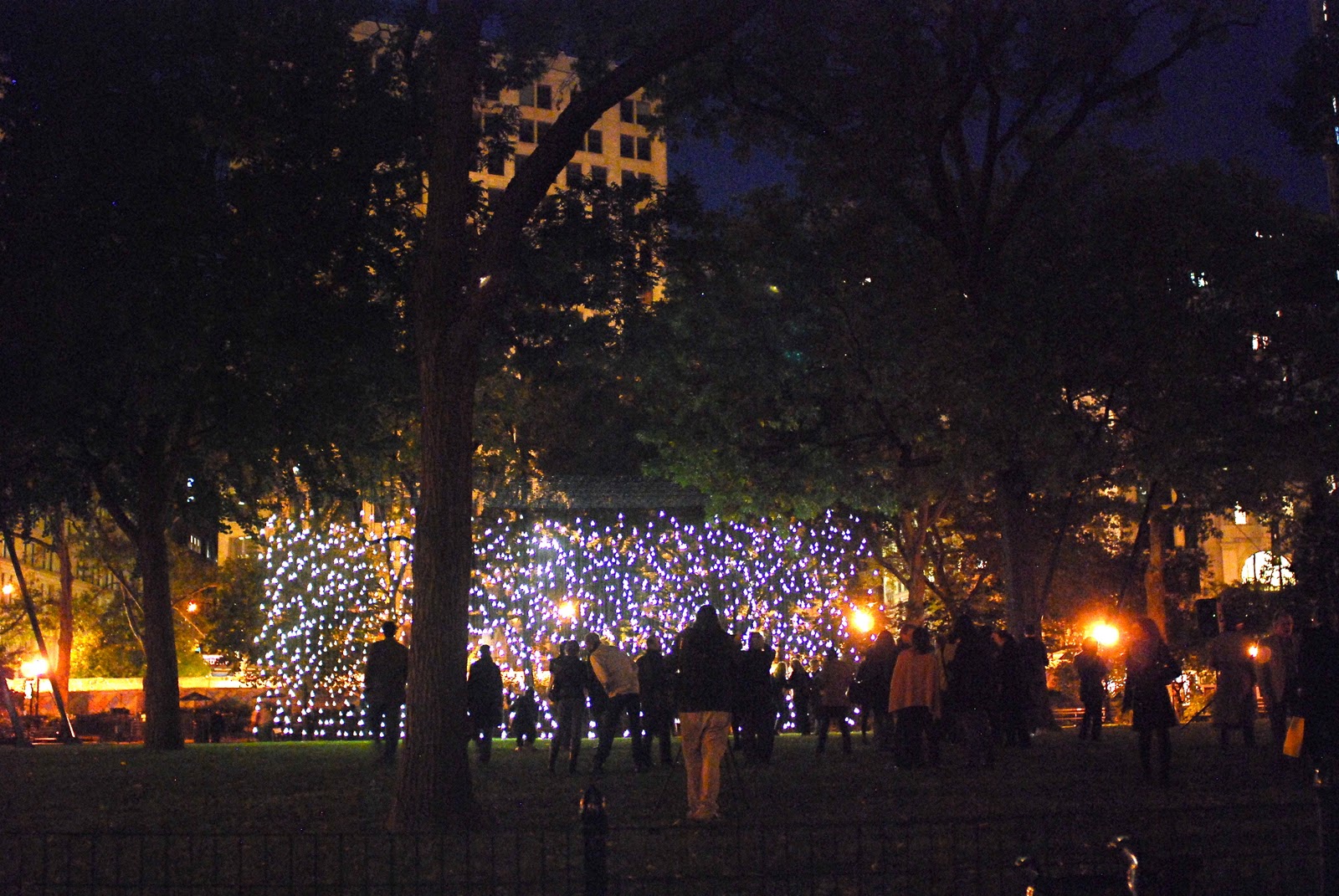
Jim Campbell's SCATTERED LIGHT Premiere At Madison Square Park

Using a Grand Central Terminal footage, Mr. Campbell programmed the LED lights to display low-resolution, moving images as individual pixels within the array.
video from abernheimer
Scattered Light, the New York public art debut of pioneering new media artist JIM CAMPBELL opened this evening at Madison Square Park. Campbell’s exhibition features three new major public art commissions, including "Scattered Light," his largest and most ambitious work to date. This mesmerizing public art installation runs through the fall and winter.


From http://www.nycgovparks.org/art and https://www.madisonsquarepark.org

With "Scattered Light," Campbell has hung nearly 2,000 LED lights, encased in standard light-bulb casings, from a massive suspension truss standing 20 feet high and stretching 80 feet down the center of the Oval Lawn. These LEDs have been programmed and sequenced by Campbell to turn and off in such a way that from the pathways of Madison Square Park—and from the major avenues beyond the park’s boundaries—it will appear as though the shadows of people and animals are passing across a massive, gently-undulating amorphous field of light.

Jim Campbell was born in 1956 in Chicago and educated at M.I.T., earning degrees in Electrical Engineering and Mathematics. A former Silicon Valley engineer, Campbell has emerged as one of the preeminent new media artists of this generation, inspired by 1970s research conducted by Bell Labs on low-resolution imagery and cognitive thresholds for accurate perception. Pixilated digital imagery has since become the lingua franca of contemporary visual culture and communication thanks to digital technology’s transformation of the way our society creates, shares and preserves images. Campbell’s art reduces both static and moving imagery to its barest essence—the pixels that serve as the elementary building blocks of so much of what we see—and poeticizes it, creating a space of exchange between artwork and viewer in which the human brain provides context and meaning to meticulously ordered and animated fragments of light. Campbell’s work is included the collections of institutions such as the Metropolitan Museum of Art, New York; The Museum of Modern Art, New York; The Smithsonian Museum of American Art, Washington, DC; The Whitney Museum of American Art, New York; the San Francisco Museum of Modern Art. He is the honored recipient of various public art commissions and awards including a Guggenheim Fellowship Award, Langlois Foundation Grant, and a Rockefeller Fellowship Award in Multimedia, among others. As an engineer, Campbell holds more than a dozen patents in the field of video image processing. His monograph Material Light was published by Hatje Cantz in 2010. Jim Campbell lives and works in San Francisco and is represented by Hosfelt, San Francisco and Bryce Wolkowitz Gallery, New York.