Tuesday, June 7, 2011

Making "EYE CONTACT" With The Museum Of Arts And Design Facade


Last Monday, June 6, an interactive installation called "Eye Contact" took over the facade of the Museum of Arts and Design, projecting giant, eerie eyeballs across the building. The installation is part of the Museum's upcoming exhibition "Otherworldly: Optical Delusions and Small Realities," in which artists construct small-scale depictions of alternate realities. In "Eye Contact," visitors to Columbus Circle can watch a pre-recorded montage of activity from the Circle through a peep-hole box. As you watch the video footage, your larger-than-life eyes will be projected onto the museum, and even divided up and combined with other people's eyes, too. The installation, created by NYU Gallatin students taking the "Technology, Art, and Public Space" course, ran from 8:30 to 11:30 PM on Monday, and the full "Otherworldly" exhibit opens on Tuesday. Try not to get too creeped out by all those peepers. 


The Museum of Arts and Design is located at 2 Columbus Circle.
Directions:

By Train
A, B, C, D or No. 1 to Columbus Circle at 59th Street;
N, R, Q or W to 57th Street and 7th Avenue
F to 57th Street and 6th Avenue
By Bus
M5, M7, M10, M20, M30 and M104 to Columbus Circle
at 59th Street or 57th Street and 8th Avenue

Sunday, June 5, 2011

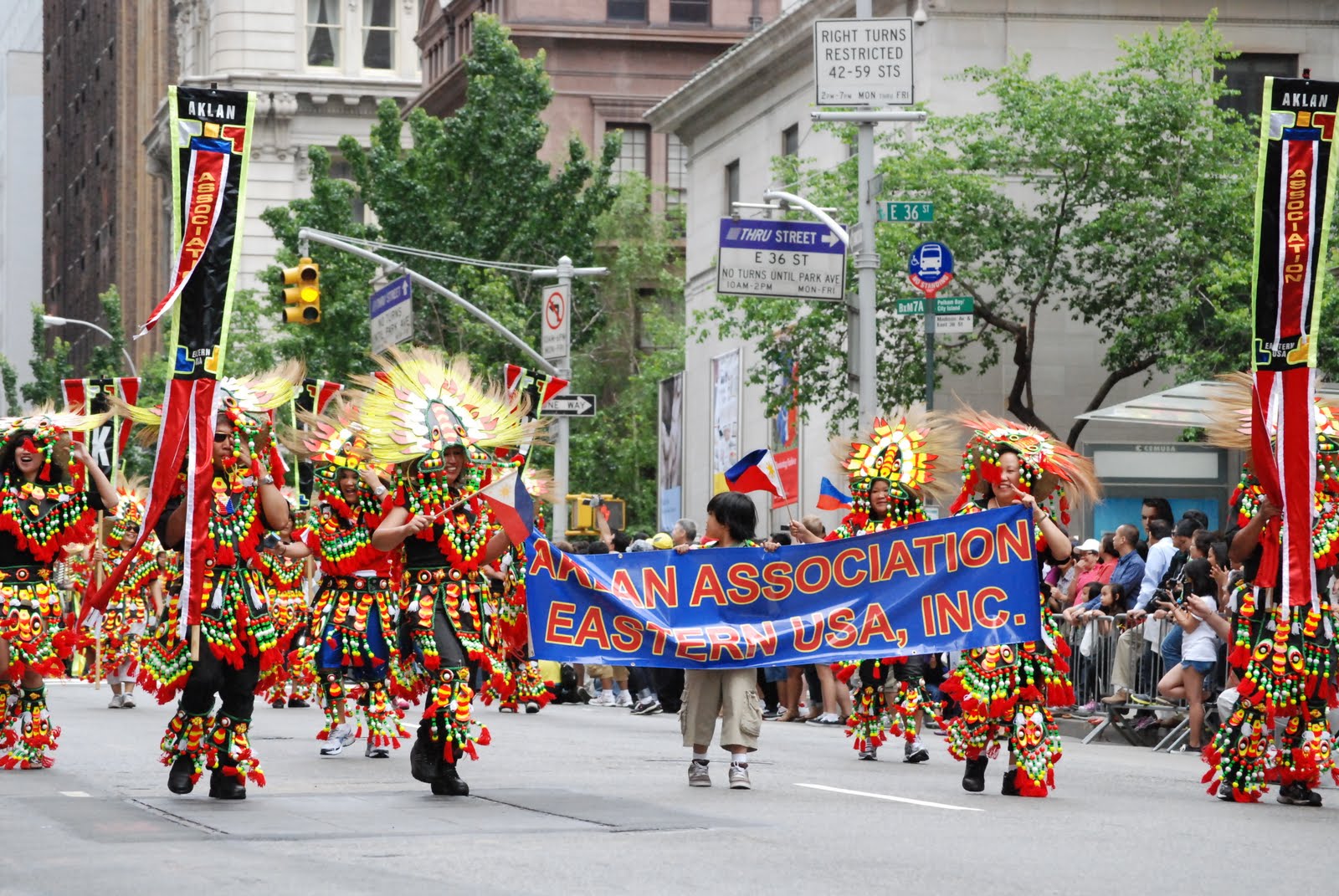
2011 Philippine Independence Day Parade


video from Letwill1258
The 2011 Philippine Independence Day Parade took place last Sunday on Madison Avenue from 38th Street down to 27th Street. Commemorating the 113th Declaration of Philippine Independence, the parade was led by Grand Marshals Nick Libramonte and Dr. Edita Cruz Libramonte, with Guests of Honor: Philippine Vice President Jejomar Binay, Philippine Ambassador to the US Jose L. Cuisia, Jr; Philippine Consul General in NY, Ambassador Mario L. de Leon, Jr., the Philippine Permanent Representatvive to the United Nations Ambassador Libran N. Cabactulan. Also invited are New York State and City Government Officials including Mayor Mike Bloomberg; Joined by the PIDCI “DIWA NG KALAYAAN”(Spirit of Independence) Winner and her Court; joined by Filipino community leaders , with contingents of marchers from Fil-Am associations, cultural groups, Marching Bands, floats, open cars, and others.

A street fair was also held on Madison Avenue, 26th Street to 24th Street until 6 PM. The fair featured Filipino food vendors with delectable Philippine cuisine and more; Mini-Expo (goods, merchandise and services), Corporate Booths, games and more.

The parade was followed by a cultural fair from 2-6 PM featuring Filipino entertainers Jericho Rosales and Karylle.

Saturday, June 4, 2011

Time Lapse Videos of Manhattan by Josh Owens

NYC - Mindrelic Timelapse from Mindrelic on Vimeo.

"NYC - Mindrelic Time Lapse"
"Viewfinder: Manhattan in Motion"
My own capture of Midtown and Upper Manhattan using an Apple iPhone 4

Josh Owens, master of time lapse videos has released two amazing time lapse videos of Manhattan. "NYC - Mindrelic Time Lapse" is a short collection of some of his favorite shots. For "Viewfinder: Manhattan in Motion," he spent a little over a month shooting time lapse videos from eleven different hotels around Manhattan. 

Friday, June 3, 2011

Merchants Market Cafe At The New Amsterdam/Dutch Pavilion

The New Amsterdam/Dutch Pavilion that houses the organic Merchants Market Cafe recently opened  at Manhattan's southern tip near the Staten Island Ferry. The pavilion is part of the 1.3-acre Peter Minuit Plaza — named for the Dutch merchant who bought the island of Manhattan from the Lenape Indians — features curving benches, gardens and a pinwheel-shaped pavilion. In honor of the 400-year anniversary of Henry Hudson's arrival in New York, the Dutch donated the $2.3 million, 5,000-square-foot New Amsterdam Pavilion, which anchors the plaza and houses the organic Merchants Market cafe, along with visitor information. To commemorate Peter Minuit, whose name means "midnight," the pavilion lights up in different colors each evening. Dutch architect Ben van Berkel, who designed the pavilion, said he conceived its four curving arms to welcome in the 150,000 people who rush through the plaza in all directions every day. "We wanted to point to many locations — many locations from which people come, to bind the activity together," van Berkel said. "It's so inviting." Department of Transportation Commissioner Janette Sadik-Khan called the plaza "the most multi-modal acre in America" because it connects pedestrians to the Staten Island Ferry, the 1 and R trains, the M15 bus and the bikeway that rings lower Manhattan. The plaza will also host events, including performances, art exhibitions and weekend markets. "It's not just a place to pass through on the way to the ferry, but a real destination," Parks Commissioner Adrian Benepe said.

Thursday, June 2, 2011

BALTO Statue in Central Park


One of the most popular statues in Central Park is that of Balto, the Siberian Husky sled dog standing nobly on a rock outcropping. The statue is located west of East Drive and 67th Street and north of the Zoo. This image was made last winter.

Back in 1925 Nome, Alaska was stricken with a horrific diphtheria outbreak. Not enough antitoxin was available to treat all the sick until teams of mushers and sled dogs battled a blinding blizzard and traveled 674 miles to deliver the medicine. Balto was one of the heroic lead dogs.

In recognition of such bravery, the famed Brooklyn born sculptor Frederick George Richard Roth was commissioned to create a lasting tribute.

Roth, whose other work at Park includes Tales of Mother Goose andDancing Goat and Dancing Bear, unveiled the statue on December 16, 1925. The most important among the honored guests was the real Balto himself.

Over the past nine decades, Balto’s statue has been a favorite as evidenced by the deep burnishing of his ears and back. Children and others frequently climb up on him for a photo opp, or to contemplate life and the stirring words on the statue’s plaque: Endurance · Fidelity · Intelligence. Good words for today's heroes and heroines too. (Information from Central Park website).

Wednesday, June 1, 2011

Sol LeWitt:Structures, 1965-2006 Exhibition At the New York City Hall Park

Splotch 15, 2005
Incomplete Open Cubes, 1974
Three-Part Different Variations On Three Different Kinds of Cubes, 1967/74
Large Modular Cube, 1969
Complex Form 6, 1987
Three X Four X Three, 1984
Double Modular Cube, 1979
Pyramid (Munster), 1987
Tower (Columbus), 1990
One X Two Half Off, 1991
Sculptures created by artist Sol LeWitt are on exhibit at City Hall Park in downtown Manhattan through December 2, 2011. Most of the artworks in this Public Arts Fund project are shown above. 

Sol LeWitt:Structures, 1965-2006, the first outdoor career survey of Sol LeWitt’s sculptures—or “structures” as he called his three-dimensional works. The landmark exhibition will include 27 works from this seminal artist’s modular, serial, geometric, and irregular structures series that attest to his lifelong engagement with the medium and present his most important ideas about sculpture.

Just a few years after his death in 2007, Sol LeWitt remains one of our most significant and radical artists. He first found his artistic voice in his structures of the mid 1960s, giving rise to a career that would change the way we think about art. Spanning more than 40 years, this exhibition traces that evolution, revealing his remarkable and sustained artistic development.