Showing posts with label Iris and B. Gerald Cantor Roof Garden. Show all posts

Friday, July 20, 2012

Tomás Saraceno On the Roof: "Cloud City" Viewed From Central Park

Cloud City by Tomás Saraceno (born in Tucumán, Argentina in 1973) is the new art installation at the Metropolitan Museum of Art's Iris and B. Gerald Cantor Roof Garden. It is a "constellation of large, interconnected modules constructed with transparent and reflective materials". Most of the published images of the artwork including this photoblog's earlier post  are taken from the rooftop of the Met. The photos above were taken from Central Park grounds. 

Thursday, May 26, 2011

Anthony Caro's Heavy Metal Sculptures On The Roof Of The Metropolitan Museum Of Art

After Summer (1968)
Odalisque (1984)
Midday (1960)
Blazon (1987-1990)
End Up (2010)
On exhibit on the roof of the Metropolitan Museum of Art are five of knighted British sculptor Anthony Caro's welded steel sculptures. Anthony Caro is considered the most influential and prolific British sculptor of his generation, and a key figure in the development of modernist sculpture. The New York Times described Caro's sculptures as "perfectly composed yet seemingly freely improvised, they gave the impression of color liberated from physical support, like paintings in space or visual jazz." The exhibit runs through October 30, 2011 at the Iris and B. Gerald Cantor Roof Garden.

Wednesday, August 4, 2010

The Iris and B. Gerald Cantor Roof Garden

The Iris and B. Gerald Cantor Roof Garden is an outdoor space of the Metropolitan Museum of Art that features modern sculpture overlooking Central Park and and stunning view of the Manhattan skyline. The roof garden opened to the public in 1987. Annual installations have featured selections of modern sculpture from the Museum's collection and, most recently, presentations of works by individual artists. Drinks such as beers, some wines, basic mixed drinks, as well as sandwiches are also available at the garden. The roof garden is accessible by the southwest elevators on the ground floor, just outside the twentieth-century art gallery. These images of museum visitors at the garden were taken last April.
Bernard Gerald Cantor (December 17, 1916 – July 17, 1996) was the founder and chairman of securities firm Cantor Fitzgerald and an important philanthropist supporting visual arts institutions in the United States. During his life Cantor assembled the world's largest private collection of works by Auguste Rodin, much of which was donated to over 70 art institutions worldwide, such as the Los Angeles County Museum of Art and the Iris & B. Gerald Cantor Center for Visual Arts at Stanford University. Along with his wife, Iris, Cantor underwrote many art exhibitions and endowed galleries at the Metropolitan Museum of Art, including the popular Iris and B. Gerald Cantor Roof Garden, as well as a sculpture garden and his namesake museum at Stanford. In 1995, he and his wife were awarded the National Medal of Arts.

Saturday, May 1, 2010

Doug and Mike Starn's Monumental Bamboo Installation: "Big Bambú" On The Roof Garden of The Metropolitan Museum of Art

This is a section of the elevated interior network of pathways roughly 20-40 feet above the Roof Garden, where museum visitors can walk along for a guided tour.
Bamboo poles to be used for the continuing construction throughout the duration of the exhibition. The skyline of Manhattan's Eastside is in the background.
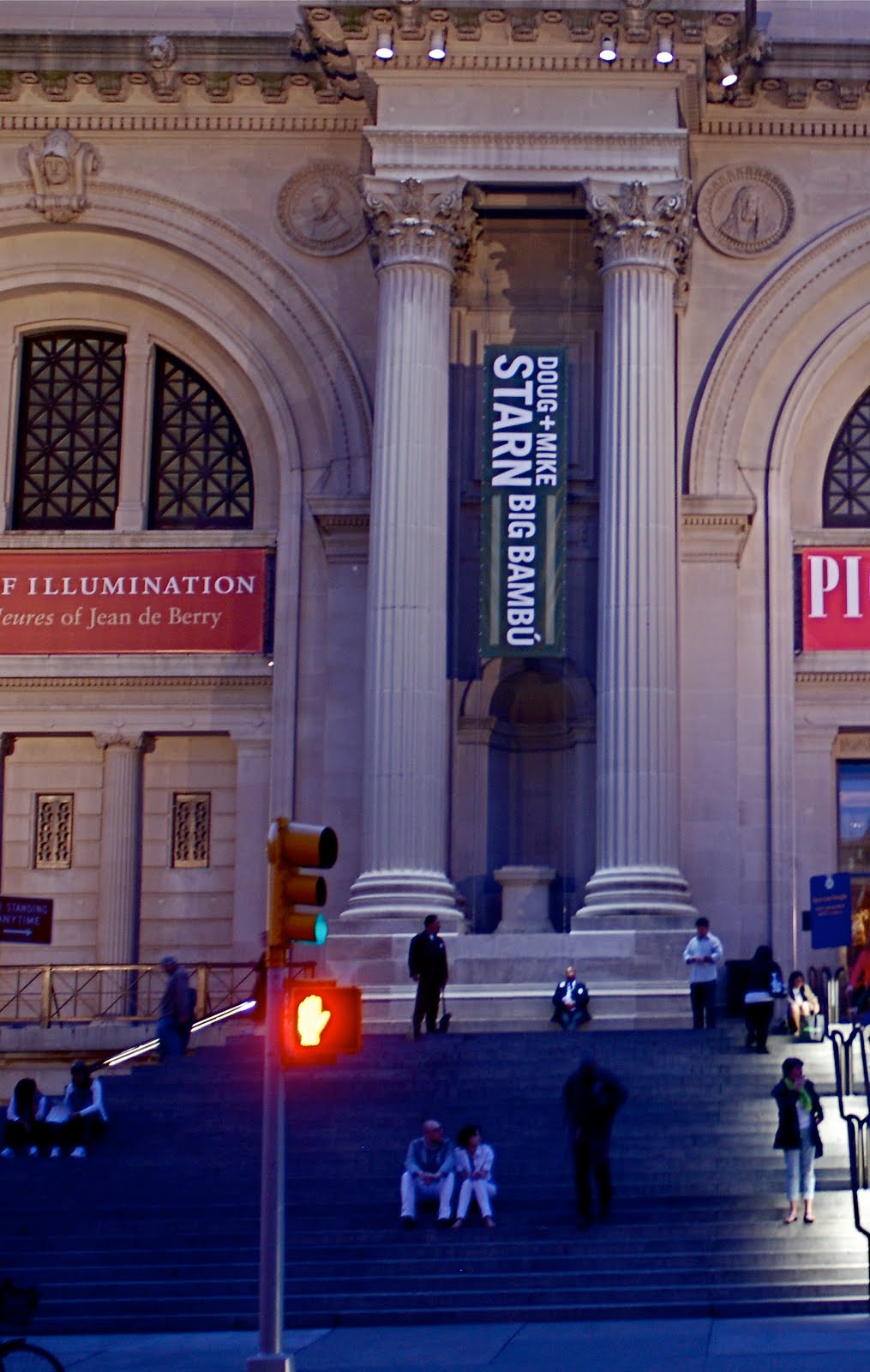
Facade of the Metropolitan Museum of Art with the banner for the Big Bambu Exhibition

Earlier this evening, I made these images of the new site-specific installation at the Iris and B. Gerald Cantor Roof Garden of the Metropolitan Museum of Art. Created by the identical twin brothers MIKE and DOUG STARN, the monumental bamboo structure is called "Big Bambú: You Can't, You Don't, and You Won't Stop". The installation will ultimately measure 100 feet long, 50 feet wide, and 50 feet high, and takes the form of a cresting wave that bridges realms of sculpture, architecture, and performance. The structure, made of thousands of interlocking 30- and 40-foot long bamboo poles woven together with more than 40 miles of rope, will continue to evolve as it is constructed throughout the spring, summer, and fall by the artists and a team of rock climbers. Set against Central Park and its urban backdrop, Big Bambú will suggest the complexity and energy of an ever-changing living organism. 
"This piece is what it means to be alive.  To be alive is to be constantly growing and changing," the Starn brothers said. "And when we say alive, we don't just necessarily mean being human. A city is alive. A culture. A society." They also say that this is what their work has always been about: playing with scale and, ultimately, our perceptions of where we stand in the world.
Born in New Jersey in 1961, the identical twins Doug and Mike Starn work collaboratively and defy categorization, combining traditionally separate disciplines such as sculpture, photography, painting, video, and installation. 
The exhibit runs through October 31.
(information from the website of the Metropolitan Museum of Art)

Monday, August 24, 2009

Cantor Roof Garden at the Metropolitan Museum of Art and Roxy Paine's "Maelstrom"


Rooftop view of verdant trees in Central Park and the skyline of midtown Manhattan


The Iris and B. Gerald Cantor Roof Garden of the MetropolitanMuseum of Art is perched over the sea of Central Park's trees, and offers a great panoramic view of the midtown Manhattan skyline. It is located on the fifth floor of the Met via the elevator in the European Sculpture and Decorative Arts Galleries. The roof garden serves cocktail and sandwiches and is open from May through late fall, weather permitting. Hours are: Friday and Saturday: 10:00 a.m.–8:00 p.m.; Martini Bar: 5:30–8:00 p.m.; Sunday, Tuesday, Wednesday, Thursday: 10:00 a.m.–4:30 p.m.; Closed Mondays.
Currently on view at the rooftop garden until November is Roxy Paine's "Maelstrom."
From the Met's website:
American artist Roxy Paine (b. 1966) has created a 130-foot-long by 45-foot-wide stainless-steel sculpture, especially for the Museum’s Iris and B. Gerald Cantor Roof Garden. Giving viewers the sense of being immersed in the midst of a cataclysmic force of nature, Maelstrom (2009) is Paine’s largest and most ambitious work to date. The latest in a diverse body of work, this sculpture is one of the artist’s Dendroids based on systems such as vascular networks, tree roots, industrial piping, and fungal mycelia. Set against Central Park and its architectural backdrop, the installation explores the interplay between the natural world and the built environment amid nature’s inherently chaotic processes.

Sunday, April 27, 2008

JEFF KOONS ON THE ROOF - new exhibit at the METROPOLITAN MUSEUM OF ART's CANTOR ROOF GARDEN


Yesterday, I visited the new JEFF KOONS exhibit at the Cantor Roof Garden of the Metropolitan Museum of Art to see the previously unexhibited works of the pop artist. I took photos of the three sculptures: COLORING BOOK, a silhouette of Piglet from a "Winnie the Pooh" coloring book, BALLOON DOG (YELLOW),and SACRED HEART (RED/GOLD), a chocolate heart wrapped in shiny red. All sculptures are glossily lacquered stainless steel works.
From the NEW YORK TIMES Art Review by Ken Johnson:
With its breathtaking, panoramic views of Central Park and the Manhattan skyline, the Cantor Roof Garden at the Metropolitan Museum of Art may strike you as an excellent place to mount a seasonal outdoor sculpture show, which it does every year. In truth, it is an inhospitable site for sculpture, as demonstrated by the 2008 display that opens on Tuesday: three wonderful, previously unexhibited works by the celebrated Pop artist Jeff Koons.
Each of these sculptures is a greatly enlarged, glossily lacquered, stainless-steel representation of something small: a toy dog made of twisted-together balloons; a chocolate valentine heart wrapped in red foil, standing en pointe; and a silhouette of Piglet from a “Winnie the Pooh” coloring book, randomly colored as if by a small child.
They are mischievously meaningful works. With its pneumatic, sausagelike parts, “Balloon Dog (Yellow)” is a sly Trojan Horse: it seems innocent but is loaded with aesthetic and erotic perversity. “Sacred Heart (Red/Gold)” acidly comments on the commercial debasement of emotional and religious experience. “Coloring Book” reflects the youth-obsessed infantilism of modern culture and society.
But placed on the architecturally nondescript patio, where there are also shaded areas for patrons of the Roof Garden Cafe, the sculptures too easily turn into benign, decorative accessories.
The biggest problem is scale. Seen in an indoor gallery, the elephantine, shiny metallic “Balloon Dog (Yellow),” which rises to 10 feet at its highest point, would have a weirdly imposing, slightly menacing presence. On the roof it appears dwarfed by the vast sky and by the open expanses of space to the south and west of the museum.
The intimacy of Mr. Koons’s sculpture is also diminished. Perfectionist attention to detail is one of his work’s most compelling aspects: note the exactingly formed knot that serves as the balloon dog’s nose, or the folds, pleats and stretch marks in the heart’s wrapper. The distracting outdoor environment, though, discourages careful, contemplative looking.
Because it is both the biggest and the simplest, the 18 ½-foot-tall “Coloring Book” is the least undermined by its environment. But it is also the least interesting formally, being little more than a flat, irregularly contoured slab whose colors are thin and watery.
Their setting aside, Mr. Koons’s sculptures remain intellectually and sensuously exciting objects — “Balloon Dog” is a masterpiece — and they are worth visiting under any circumstances.
“Jeff Koons on the Roof” is on view through Oct. 26 at the Metropolitan Museum of Art; (212) 535-7710 or metmuseum.org.

Sunday, July 8, 2007

FRANK STELLA ON THE ROOF


Earlier today, I visited the special exhibition at the Metropolitan Museum of Art called “FRANK STELLA ON THE ROOF,” featuring the recent works in stainless steel and carbon fiber by the prolific American artist Frank Stella (b. 1936) at the Iris and B. Gerald Cantor Roof Garden. This sculpture exhibition marks the artist’s first solo presentation at the Met, simultaneous with Frank Stella: Painting into Architecture, on view through July 29. The roof garden, aside from being an exciting outdoor space for sculpture, offers spectacular views of Central Park and the Manhattan skyline.