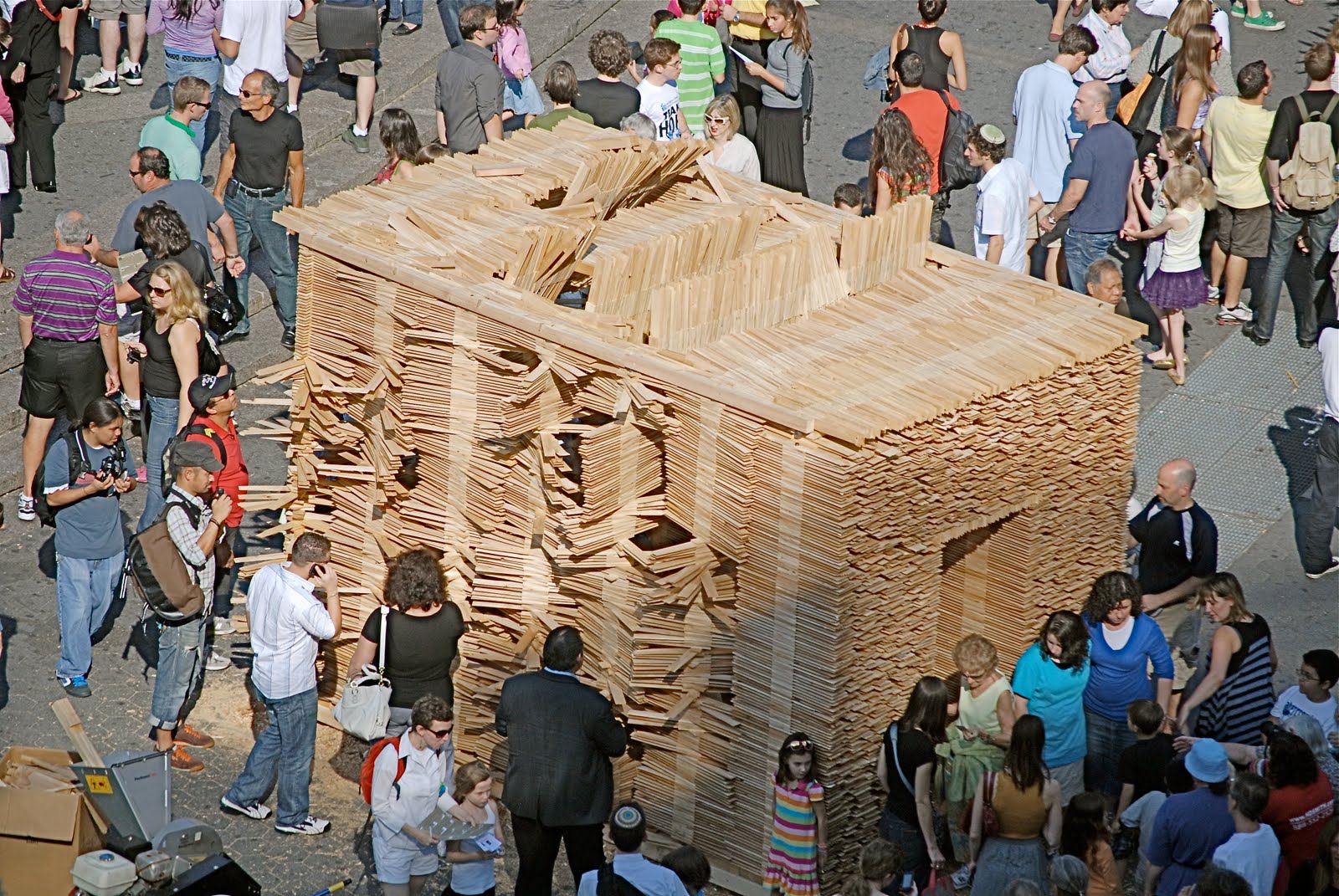
Sukkah is a temporary, elemental shelter, erected for one week each fall, in which Jews gather to share meals, entertain, sleep, and celebrate Sukkot, the harvest festival. Biblical in origin, the sukkahs have traditionally been made with sticks and leaves and twine. A sukkah design competition called Sukkah City is being held in New York City, and 12 finalists have been chosen. The architects had to follow the Jewish law, which requires a sukkah to have at least three walls (two full and one partial) that can resist strong winds. By day the roof must provide more shade than sunshine. By custom it must also allow views of the stars at night. The 12 radically temporary structures are on display for two days in Union Square Park.
Showing posts with label Union Square Park. Show all posts
Monday, September 20, 2010
Thursday, April 1, 2010
Mohandas Gandhi Sculpture in Union Square Park
This bronze sculpture depicting Mohandas Gandhi (1869–1948) was sculpted by Kantilal B. Patel (born 1925). After its dedication on October 2, 1986, the 117th anniversary of Gandhi’s birth, the sculpture joined monuments to Washington, Lafayette, and Lincoln in Union Square Park as a quartet of works devoted to defenders of freedom. Noted civil rights leader Bayard Rustin (1912–1987) was the keynote speaker at the dedication.
The monument, donated by the Gandhi Memorial International Foundation and underwritten by Mohan B. Murjani of Murjani International, Ltd., was installed at Union Square because of the tradition of protest associated with the park. The champion of nonviolent protest and Indian independence from Britain, arguably one of the most important figures of the 20th century, is seen here grasping a staff in his right hand, looking towards a point on the horizon, and walking forward. Clad in sandals and a cotton dhoti, Gandhi’s dress illustrates his Hindu asceticism as well as his support for Indian industries. After its installation the monument became an instant pilgrimage site, with an annual ceremony taking place on Gandhi's birthday, October 2.
In 2001, Parks conserved the statue after it had been removed temporarily to facilitate the construction of a water main beneath the site. In 2002, the piece was reset on a more naturalistic stone base and the landscaped area around the monument, known as Gandhi Gardens, was expanded and improved. (from nycgovparks.org)
Saturday, May 23, 2009
Union Square Park
Last Sunday, I made these images of the south end of UNION SQUARE PARK from the 7th Floor of the department store called Filene's Basement.
From wikipedia:
Union Square is an important and historic intersection in New York City, located where Broadway and the Bowery came together in the early 19th century; its name does not celebrate either the federal union or labor unions but rather denotes the fact that "here was the union of the two principal thoroughfares of the island" and the confluence of several trolley lines, as in the term "union station." Today it is bounded by 14th Street to the south, Union Square West on the west side, 17th Street on the north, and on the east Union Square East, which links together Broadway and Park Avenue South to Fourth Avenue and the continuation of Broadway. Union Square Park is under the aegis of the New York City Department of Parks and Recreation.
Neighborhoods around the square are the Flatiron District to the north, Chelsea to the west, Greenwich Village to the south, and Gramercy to the east. Many buildings of The New School are near the square, as are several dormitories of New York University.
The eastern side of the square is dominated by the Zeckendorf Towers, and the south side by One Union Square (1999), which was voted "New York's Ugliest Building" by a panel of architects assembled by the New York Post. It features a kinetic wall sculpture and digital clock expelling bursts of steam, titled Metronome.
Union Square is noted for its impressive equestrian statue of George Washington, modeled by Henry Kirke Brown and unveiled in 1856, the first public sculpture erected in New York since the equestrian statue of George III in 1770 and the first American equestrian sculpture cast in bronze. Other statues in the park include the Marquis de Lafayette, modeled by Frédéric-Auguste Bartholdi and dedicated at the Centennial, July 4, 1876, Abraham Lincoln, modeled by Henry Kirke Brown (1870), and the James Fountain (1881), a Temperance fountain with the figure of Charity who empties her jug of water, aided by a child; it was donated by Daniel Willis James and sculpted by Adolf Donndorf. A newer addition is a statue of Mahatma Gandhi in the southwest corner of the park, added in 1986, to mark Union Square's history of social activism.
Subscribe to:
Posts (Atom)