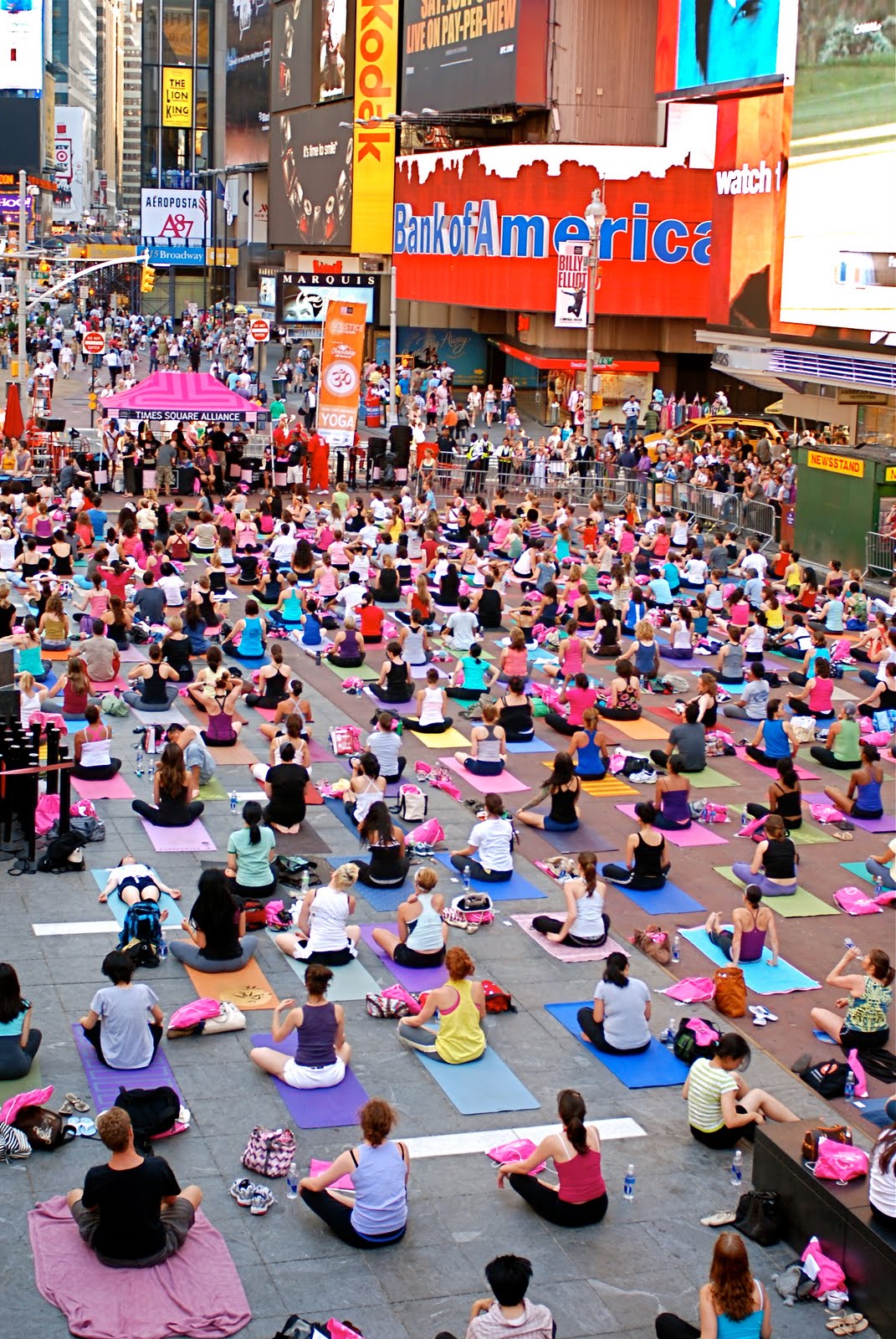
A free yoga-fest was held yesterday in the heart of Times Square at the intersection of Broadway and 7th Avenue between 43rd and 44th Streets. I made these images of yoga enthusiasts who seemed to find tranquility and transcendence in the midst of the urban energy. These pictures were taken during the Bikram Yoga session taught by Santiago Solis. Bikram Yoga is a form of Hatha yoga conducted in a heated room which is why this class is being held at high noon!
Bikram Yoga is a beginning yoga series for everyone! In the 90 minute class, one will work every muscle, tendon, ligament and joint in the entire body giving an incredible sense of well being.
Wikipedia defines Yoga as a group of ancient spiritual practices designed for the purpose of cultivating a steady mind. It originated in India possibly as early as 3300 BCE. A practitioner of Yoga is called a Yogi or Yogini. Yoga has been defined as "technologies or disciplines of asceticism and meditation which are thought to lead to spiritual experiences and a profound understanding or insight into the nature of existence." Outside India, yoga is mostly associated with the practice of asanas (postures) of Hatha Yoga or as a form of exercise. Many Hindu texts discuss aspects of yoga, including the Upanishads, the Bhagavad Gita, the Yoga Sutras of Patanjali, the Hatha Yoga Pradipika, and the Shiva Samhita. Major branches of yoga include: Hatha Yoga, Karma Yoga, Jnana Yoga, Bhakti Yoga, and Raja Yoga. Raja Yoga, established by the Yoga Sutras of Patanjali, and known simply as yoga in the context of Hindu philosophy, is one of the six orthodox (āstika) schools of thought.
The Sanskrit term yoga has many meanings. It is derived from the Sanskrit root yuj, "to control", "to yoke", or "to unite". Common meanings include "joining" or "uniting", and related ideas such as "union" and "conjunction". Another conceptual definition is that of "mode, manner, means" or "expedient, means in general".